About This Blog

My current research obsession is centered around purses and pouches from the European Middle Ages, and the accompanying hardware and passementerie. It is my hope to not only study extant items but also learn via reconstructive experiments; these will be limited for the most part to the textile components, however in the future I hope to explore the production of the metal frames.
Showing posts with label museum visits. Show all posts

28 February 2009

How could I forget?!

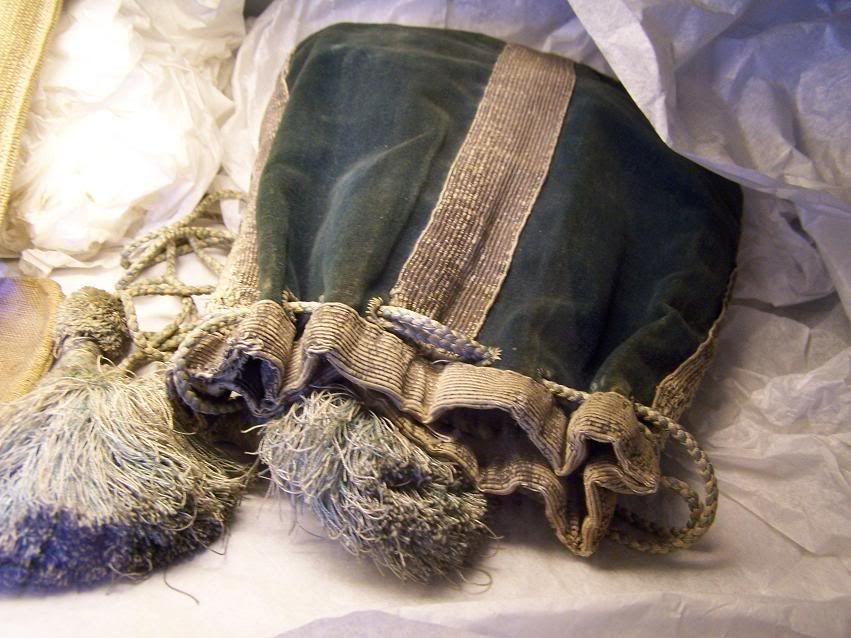
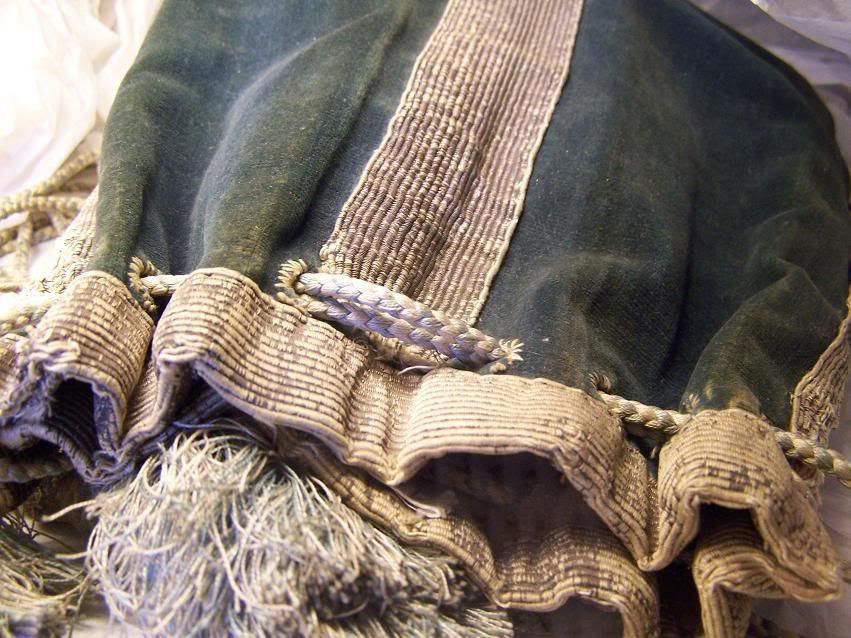
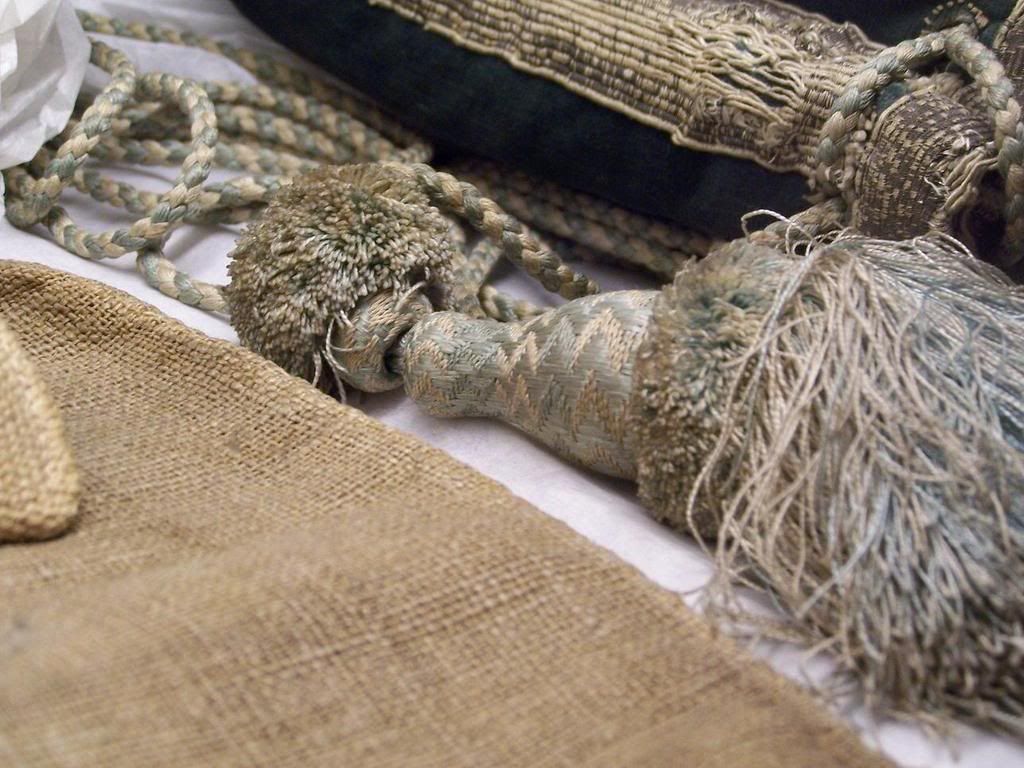
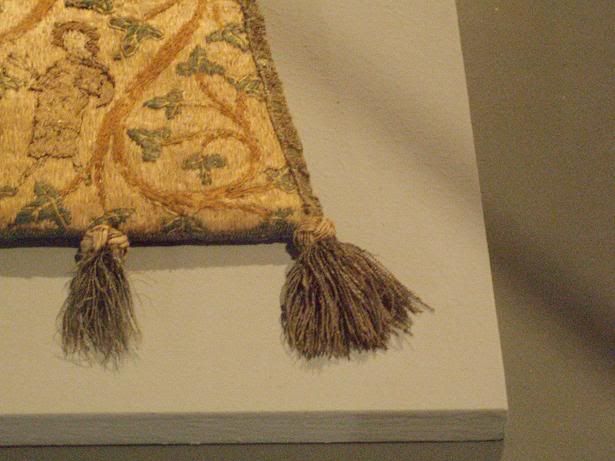
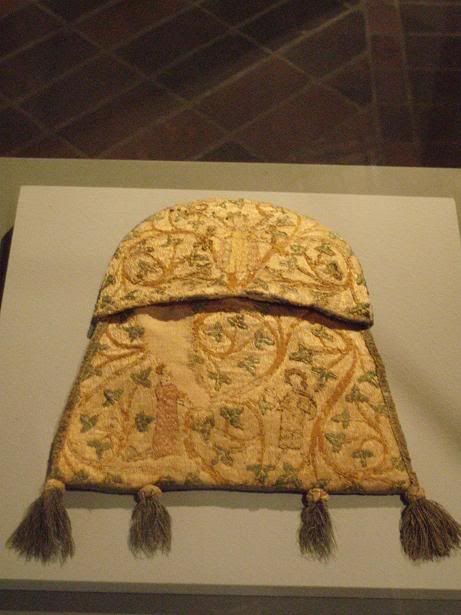
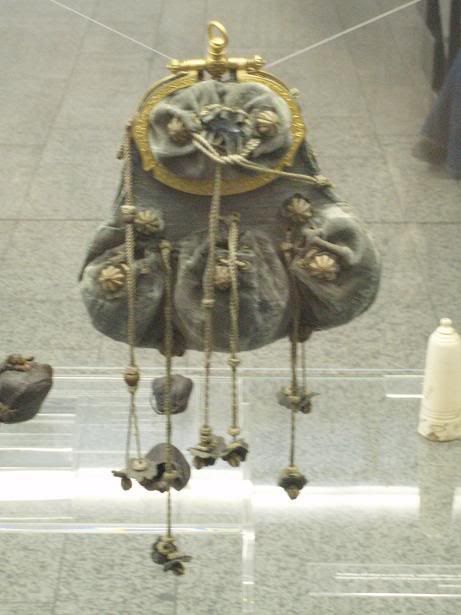
Last April, during a 2-week holiday in Switzerland (I really needed to get out of NY and away from my job, who could blame me?), I happened upon this velvet purse in the Historiches Museum in Lucerne:


Unfortunately, I don't have much information to share with you. It was described as a "purse of blue velvet lined with buckskin"; the acquisition number is 2E-2.04.01.

Surprisingly the museum director, a Dr. Heinz Horat, was kind enough to speak with me. Unfortunately, he wasn't able to produce much more information than what I already had (yes, he actually went and dug through paperwork for me). He explained that many of the museum's acquisitions were collected in the 19th century, during which time the building was an armoury. Thus, when it was turned into a museum, they were rich in artefacts but poor in documentation. Dr. Horat surmised that the purse dated from the 18th century.

14 February 2009

A selection of pictures from the Germanisches Nationalmuseum

First, a trapezoidal purse. Well, not just any trapezoidal purse, but one I've seen black and white images (here, here, and here) of before, and now have finally seen in person:


Bestickte Tasche mit Liebesgott und Liebespaar (GNM # T 1213)
ca. 1301–1315

I'll definitely be talking more about this (and trapezoidal purses in general) in a forthcoming post, so I'll hold off commentary for now.

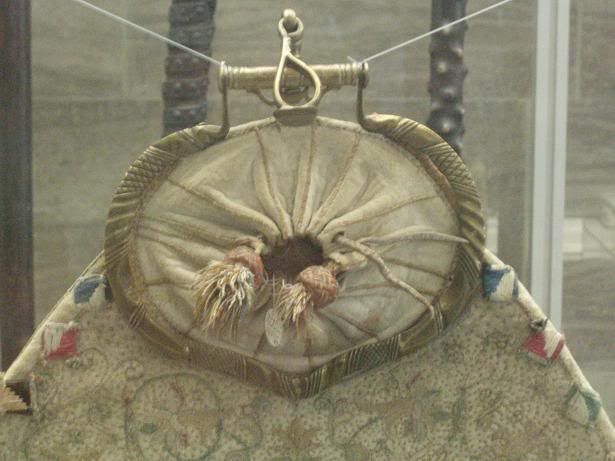
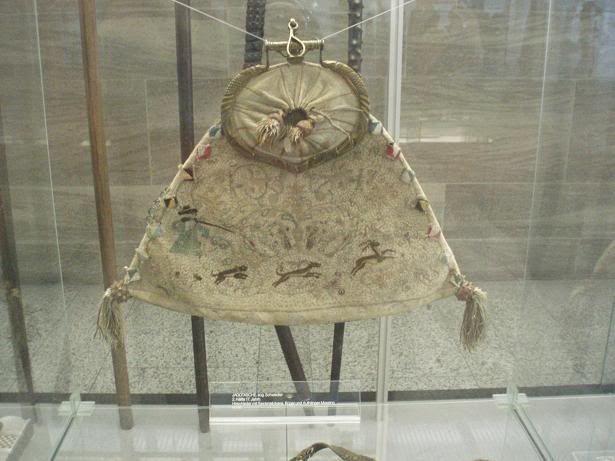
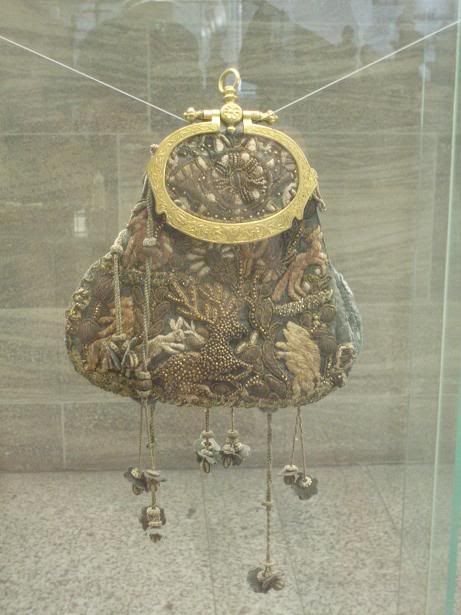
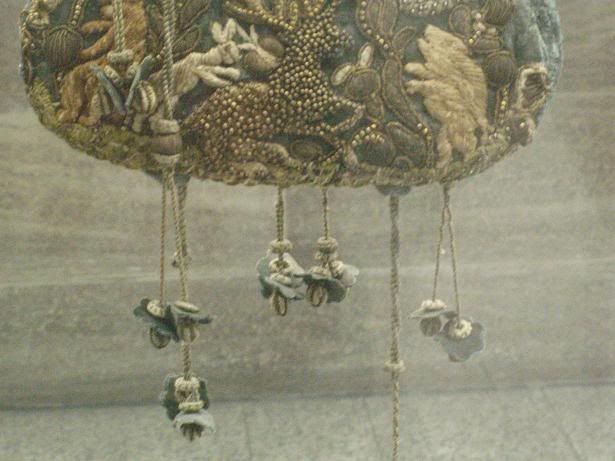
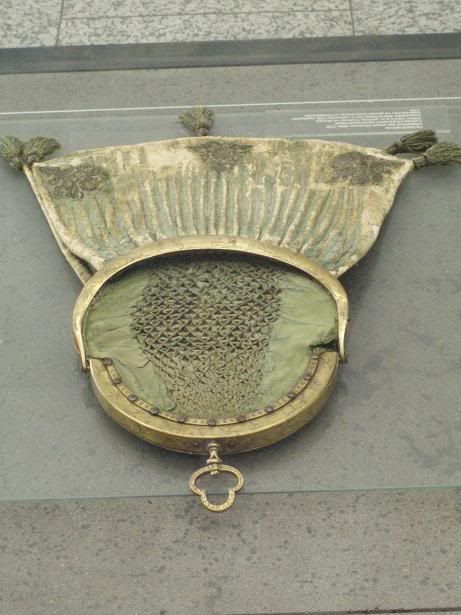
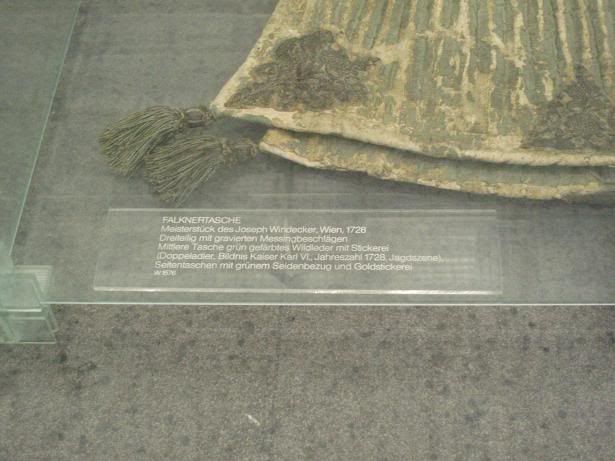
Some hunting purses. These were all amazing, particularly the second one down for its embroidery and beadwork, and the third one down for sheer size. Dimensions weren't given, and I'm not so hot about eyeballing size. But let's just say that normally when I think of "purse", I think of something dainty, or something small but utilitarian to strap to your belt. This thing reminded me more of a book-bag. Seriously, you could stuff one of your hunting dogs in this thing.


[top] Jagdtasche, sog. Schwedler (GNM # ???), ca. 1650 - 1699
[center] Jagdtasche, sog. Schwedler (GNM # W 3188), ca. 1600 - 1649
[bottom] Falknertasche (GNM # W 1576), 1728

Still not sure how to translate "Falknertasche", but possibly a falconer's bag? I'll ask my German teacher.

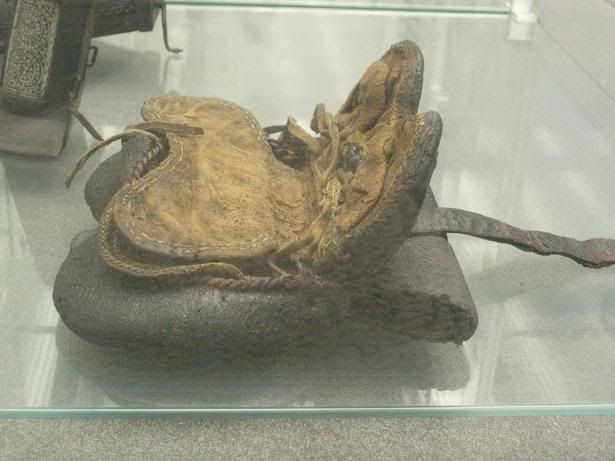
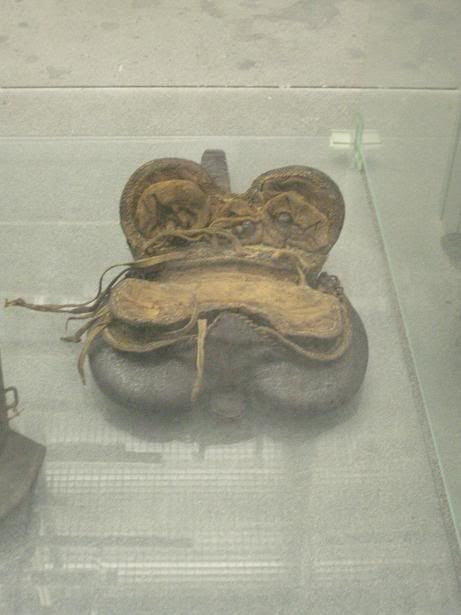
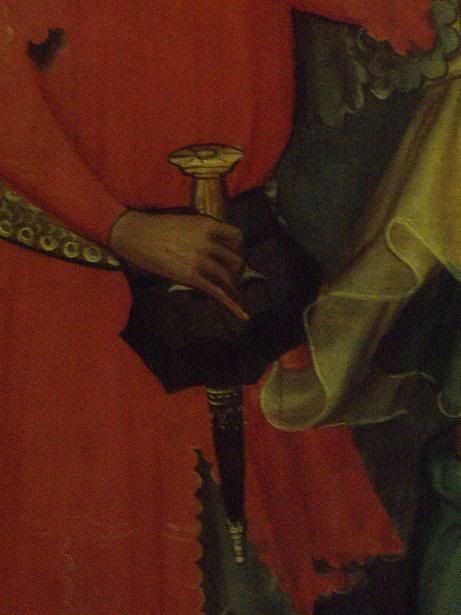
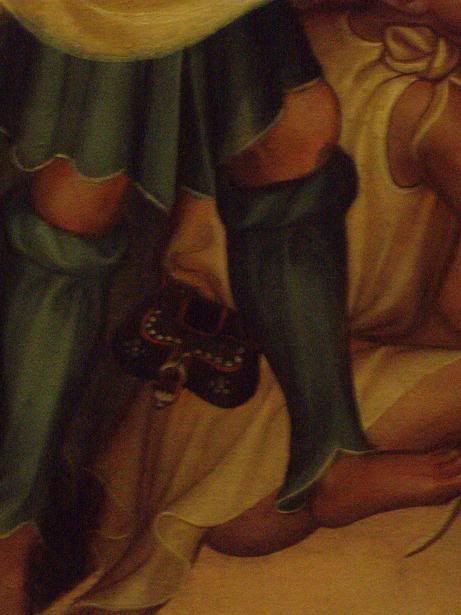
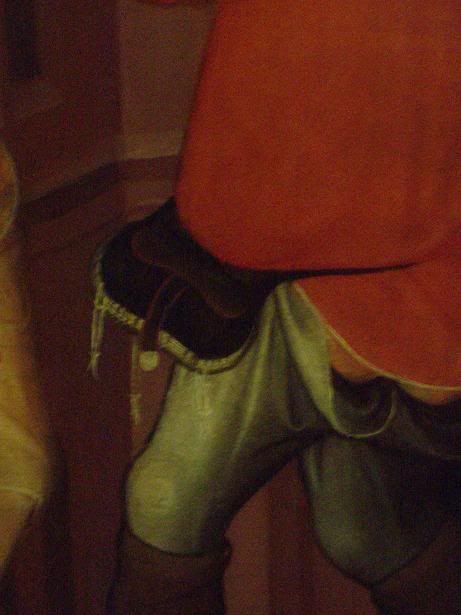
Next, an extant girdle pouch, and some artistic representations. Would you believe that the museum didn't have a little info plaque for this little leather beauty? Me neither. I'm pretty sure I circled the case a few times looking for one but all in vain. Better luck next time (yes, I really hope there's a next time).


[top] leather girdle bag; acq. # ???, date ???
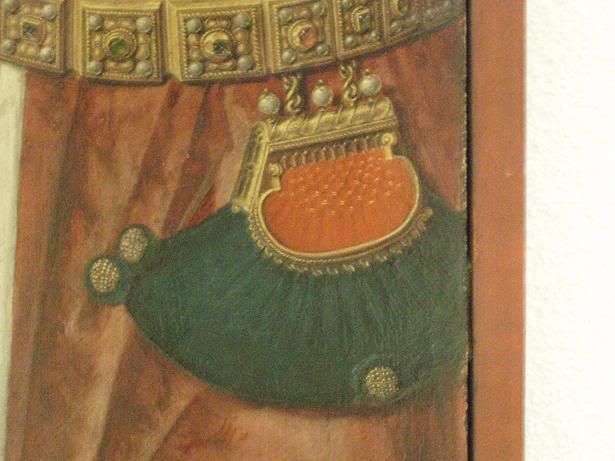
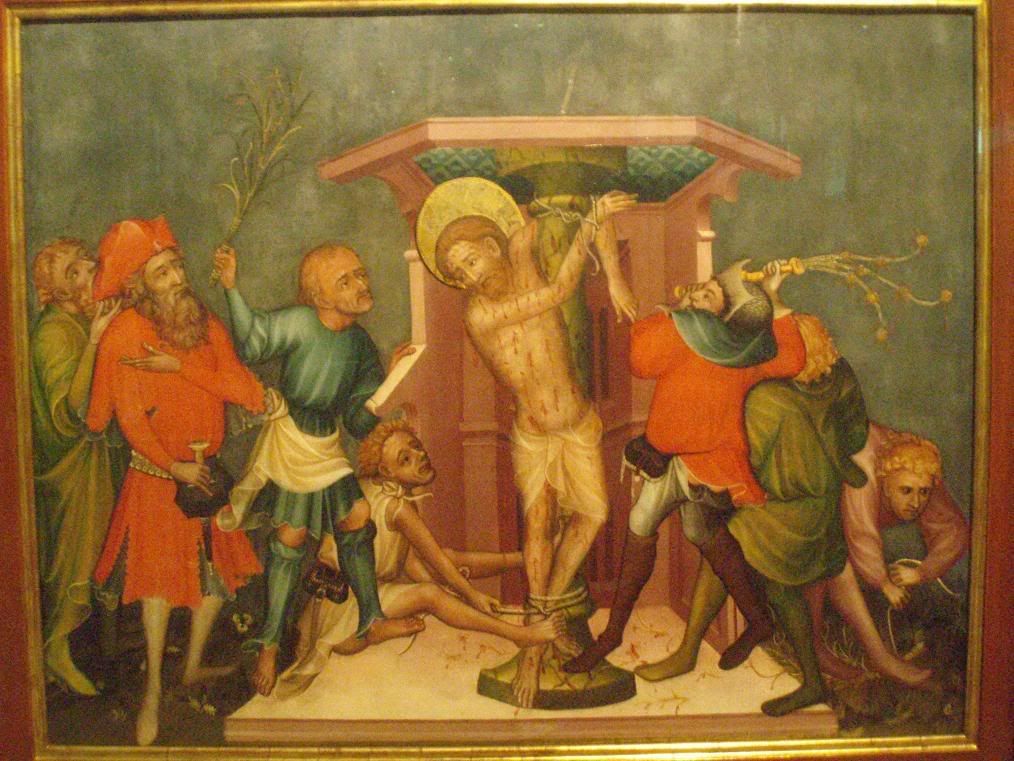
[bottom] details from the Geißelung Christi (GNM # Gm 113a), ca. 1400 - 1410
Click here to see the whole painting.


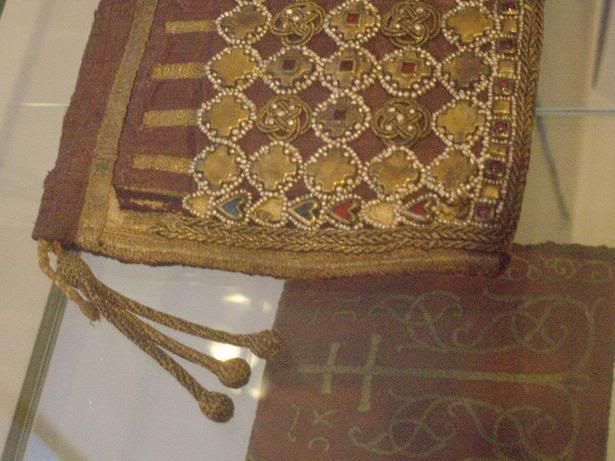
A reliquary bag. I'd be very interested to try an make something like this, with the small metal plaques and pearls and metal thread everywhere. All my photos of this piece are a bit hazy, due to the glare off the glass. However, I'd like to point out the fact that, yes, there is a mirror placed underneath the purse, so you can see the reverse side. What a novel concept! Other museums, take note.


Reliquienbeutel (GNM # KG 562), ca. 993


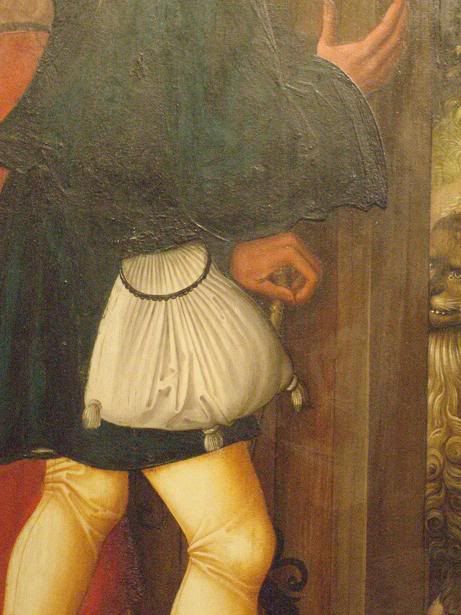
Lastly, two paintings and a sculpture:


[left] Werkstatt des Hans Traut (?), Altar aus der Nürberger Augustinerkirche
(GNM # Gm 142-148), 1487
[middle] Meister der Lyversberger Passion, Die Anbetung der Könige
(GNM # Gm 989), ca. 1460
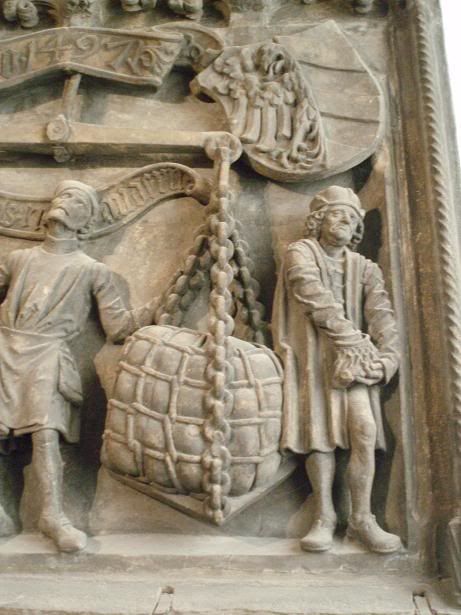
[right] Adam Kraft, Relief von der alten Stadtwaage
(GNM # PI 2849), ca. 1460 - 1509


There are plenty of other pictures I could put up here, but these were the highlights. More detailed commentary will have to wait for another day.

03 January 2009

More fingerloops and a sketch

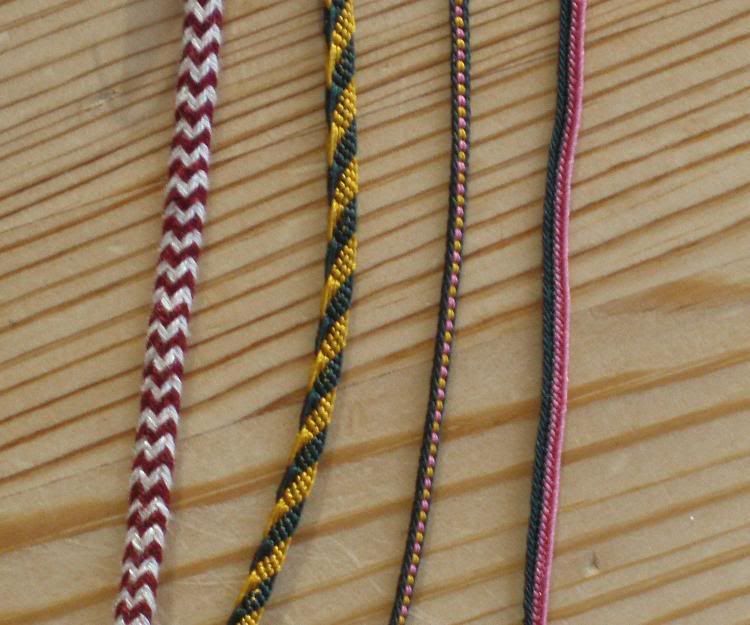
First things first.. more fingerloops. From left to right we have: A Lace Dawns (#13); A Lace Bend Broad (#24), strange but interesting; A Grene Dorge (#38), which is the first fingerloop pattern I ever learned, taught by Lois Swales herself (a researcher of such things whom I know from Ithaca); and A Broad Lace Party (#23), which I really like but holy hell is it time-consuming.


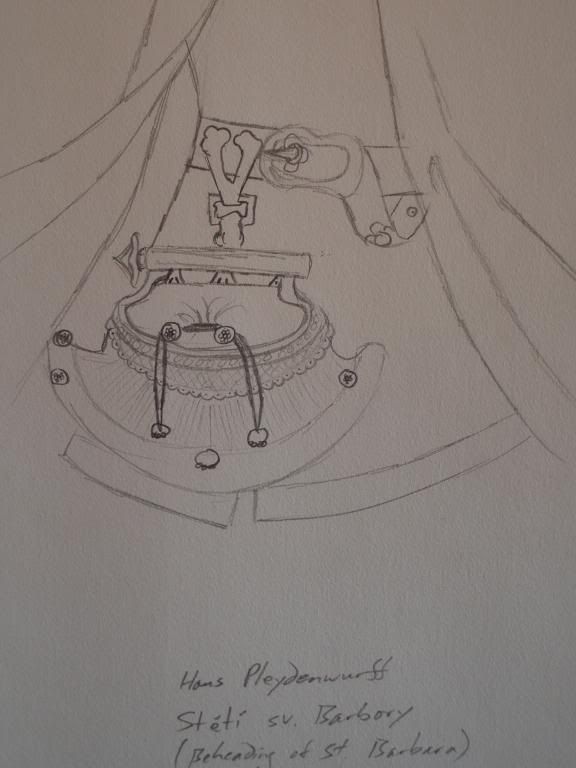
In other news, a second trip to the St Agnes of Bohemia Convent yielded this sketch of Pleydenwurff's Beheading of St Barbara (first referred to in this post). I am no great artist, much less with a pencil and paper. But at least you can get the gist from this. Or I can. Hopefully you all can visit it in person, because this doesn't do it much justice:

31 August 2008

St Agnes of Bohemia, continued

Quick post tonight, about the other noteable purse representations in the convent-cum-museum:

Epitaph with the Assumption and Donors by Hans Pleydenwurff (Nürnberg, ca. 1470): a slim rectangular leather purse, suspended from (and attached directly to) the belt via a pair of chains. Looks like the attachment points at the belt were shaped like spades, and the attachment points on the top face of the purse were shaped like spades. I think I'm reading too much into it already by identifying them as such and such shapes, but honestly.. that's what they looked like. There was also some sort of plaque in the middle of the flap.. something you'd assume, on a modern purse, would conceal a snap-closure behind it. Again, I'm reading into it from a much too modern a perspective. But, haven't not seen any extant examples of this type, I don't know else how to describe it.

Another tidbit about this piece of art, in general, was the paternoster carried by the donor's wife (?). I wish I had a picture for Chris Laning at Paternosters, although maybe nothing she's never seen before, there was a nice single marker bead ("ave"? I think I meant gaud) that looked like a sphere of silver encrusted with tiny gems.

In another piece by Hans Pleydenwurff, the Beheading of St Barbara, there was a nice frame purse; black with a gold frame.. no tassles, but there were several knopfs that seemed to be decorated with pearls. No sketch of this can do it justice, I just really need to get permission to take a picture.

Lastly, St Christopher with the Infant Jesus (Sv Kryštof s Ježískem)... a wooden relief, by an unknown Bohemian artist ca. 1500-1510, with what Goubitz referrs to as a "harp frame" purse. When I'm reunited with my copy of the book I'll recheck this (otherwise back me up or correct me), but I seem to recall that he categorized this "type" soley on examples in art, since he had never seen an extant example. It is frustrating, because it's really difficult to figure out how they work without being able to hold one, or at least see one in the flesh.

P.S. Regarding the taxonomy Goubitz established: I love K. Larsdatter's site, particularly the purse page. However, I don't think I completely agree with some of the examples she's listed under the "harp frame" type. Of course, again due to the fact that these examples are all artistic representations, it can get a bit subjective. So that's just me :-)

That's all for now!

24 August 2008

A visit to the St Agnes of Bohemia Convent..

..wherein resides an impressive collection of medieval art. There, I had the chance to see - quite possibly - more wood-and-polychrome Madonnas With Child than I would ever expect to find under one roof.

Fortunately for me (as, let's face it, M.W.C.s are not really my medieval cup o' tea) there were some pieces of art that had purses in them! Good thing I brought my little notebook. I wish that photography was allowed (even though I don't have my camera, I could steal someone else's next time.. but it's a moot point) so I could share some pictures, but alas. At the very least, I'll try to make some drawings based on my notes and in-museum sketches, but don't hold your breath.

First off, a nice clear example of a ring-frame purse in the Entombment (Kladení Krista do hrobu) scene of the Třeboň Altarpiece (Oltář třeboňský) by [surprise!] the Master of the Třeboň Altarpiece (Mistr Třeboňského oltáře), dated at around 1380-1385. The purse is worn by one of two men who are lowering Christ's body into the tomb, while the Virgin Mary, Mary Magdalene(?), and a few other haloed persons* watch. It's undecorated, and I can only assume that it would've been executed in leather. What drew me to it was the way it's attached to the man's belt (even though I can't really see a belt at all.. there's a fold in his tunic, I'll have to assume he's got a belt under there somewhere). Around a tertiary loop on the frame** is wound a small leather strap, complete with buckle. The strap also shows a few extra belt holes as well. Why? Is the ability to adjust your purse by a few centimeters closer or further from your midsection all that necessary? Could it be that the gentleman in question had only a leftover bit of belt/garter/etc strap to which he could fasten purse to belt, or was the strap "part" of the purse itself? I have no idea; all I know is I haven't yet seen many extant examples of fastening devices included with the purse.

In another painted panel, the Visitation (Navštívení Panny Marie) scene of the St James Altarpiece (Oltář svatojakubský) by the workshop of the Master of the Rajhrad Altarpiece (Mistr Rajhradského oltáře), dated around 1430, St Elizabeth is wearing a purse very similar in design to this French purse: LACMA obj. M.91.165. St Elizabeth's, however, has a main knopf/tassle on the base of the purse, and one on each of the two drawstrings (does that French purse have 3 drawstrings??). Also, I noticed that there was some sort of donut-shaped bead right about the opening. I was curious as to whether or not that was some sort of slider to help keep the purse closed (as if gravity weren't enough) or to keep prying fingers out (as if they couldn't simply cut the suspension loop and run off with the whole thing.. see Goubitz's Purses in Pieces). It could be something akin to the 'ears' seen on the French one (to aid in opening), but I'm not convinced. I'm not actually convinced that both those knopfs on the French purse are 'ears'.. there's something going on in the one in the background.

There were two more, but this post is getting a wee bit long, and believe it or not, I actually have some work to do :-( I'll discuss the other ones later, and hopefully have some sketches at some point too!

*OK, I have the details somewhere, just not with me at the moment. It's besides the point anyhow.
**I promise a diagram!