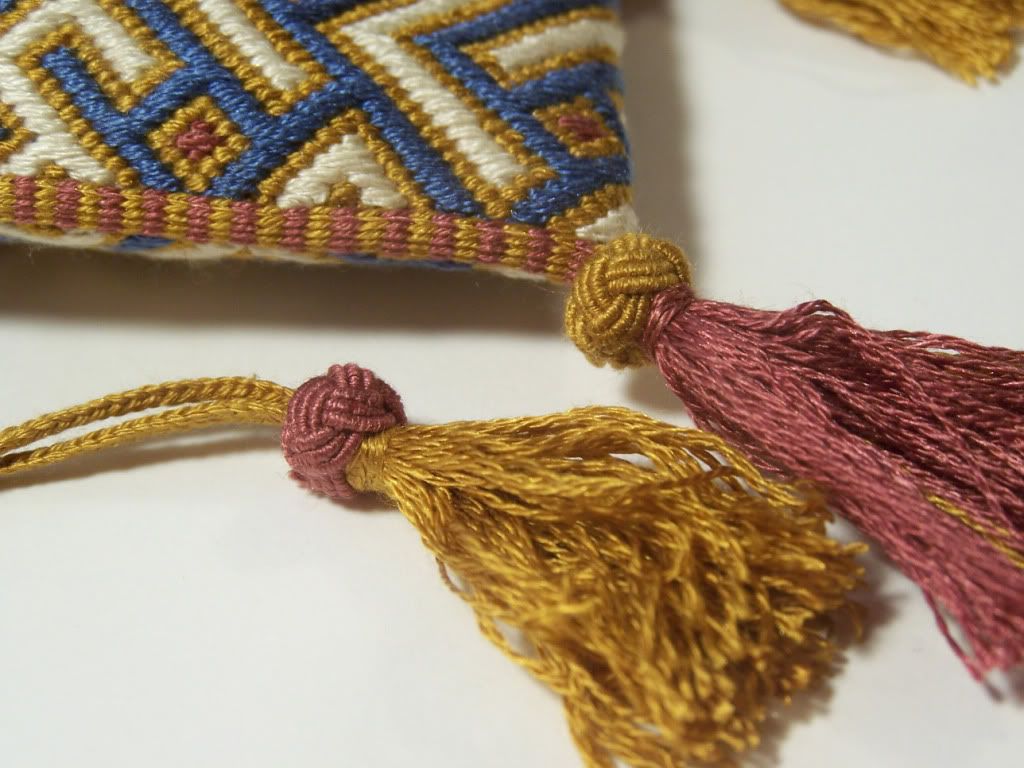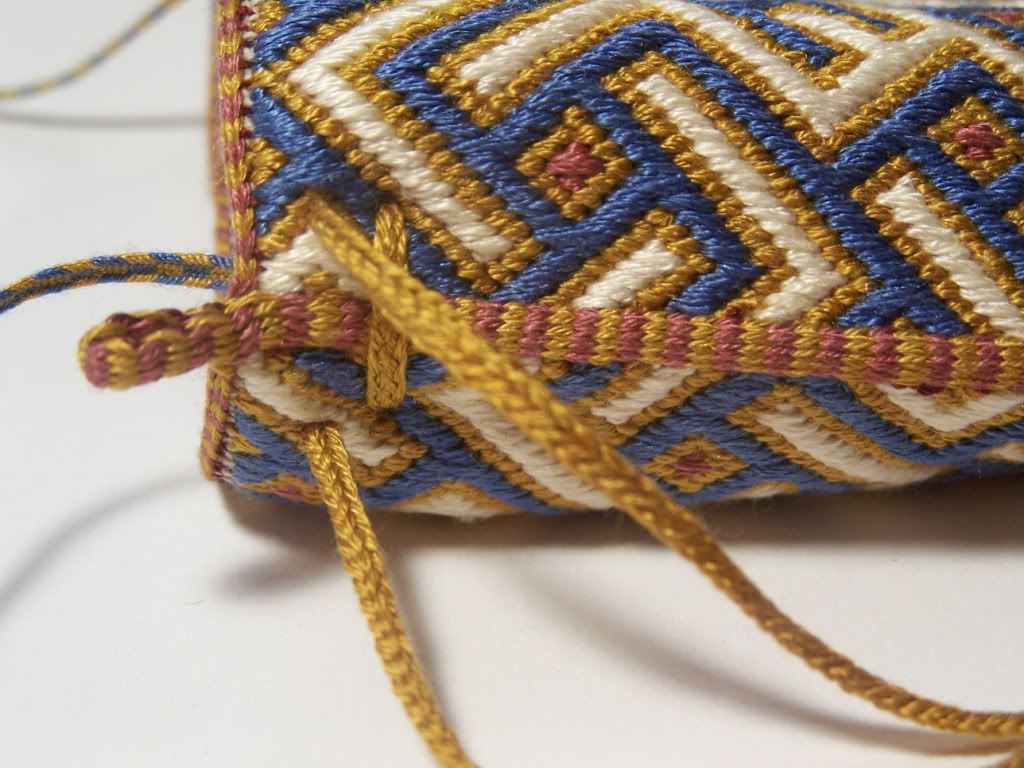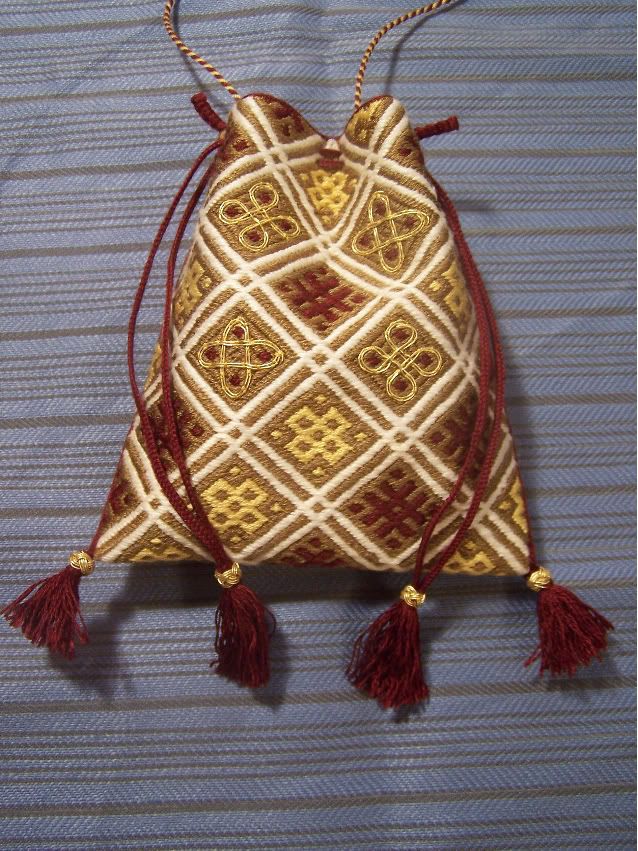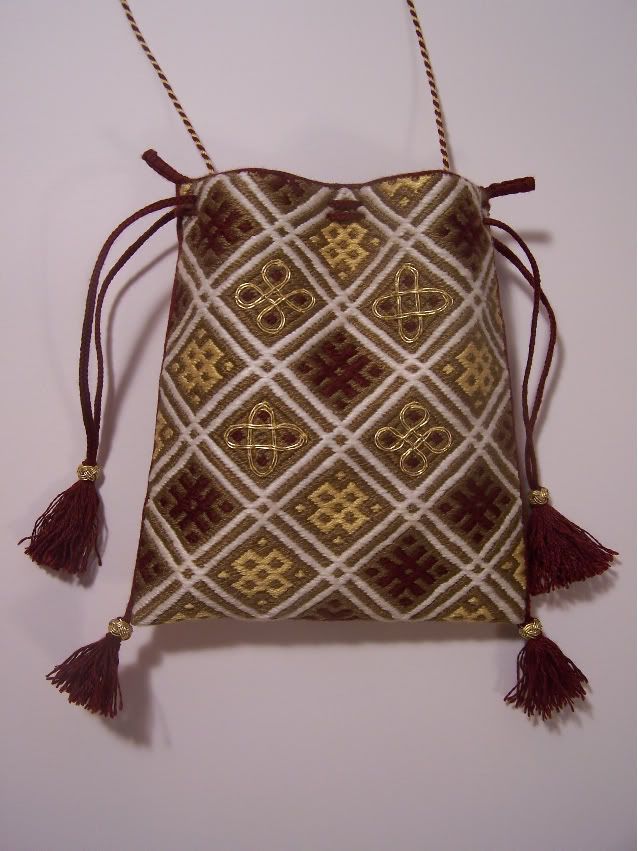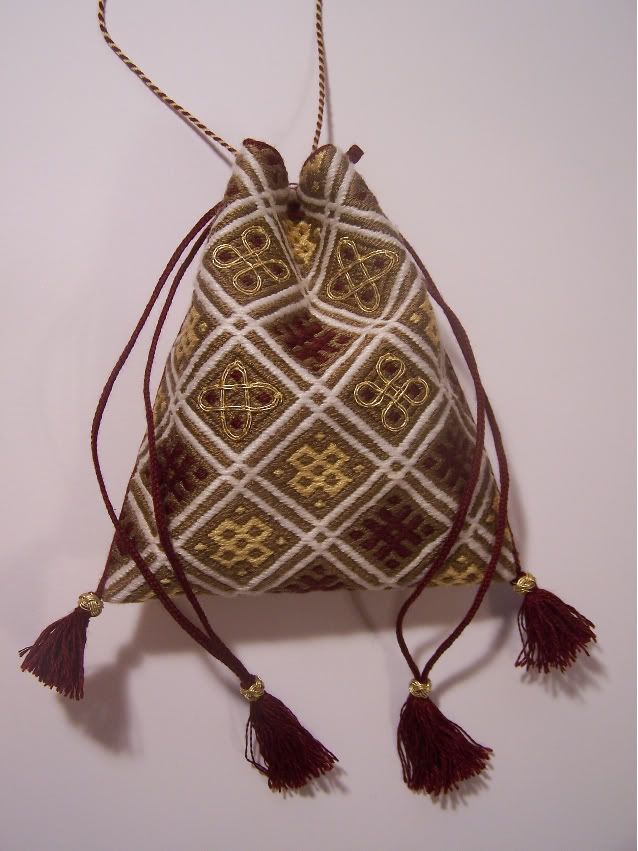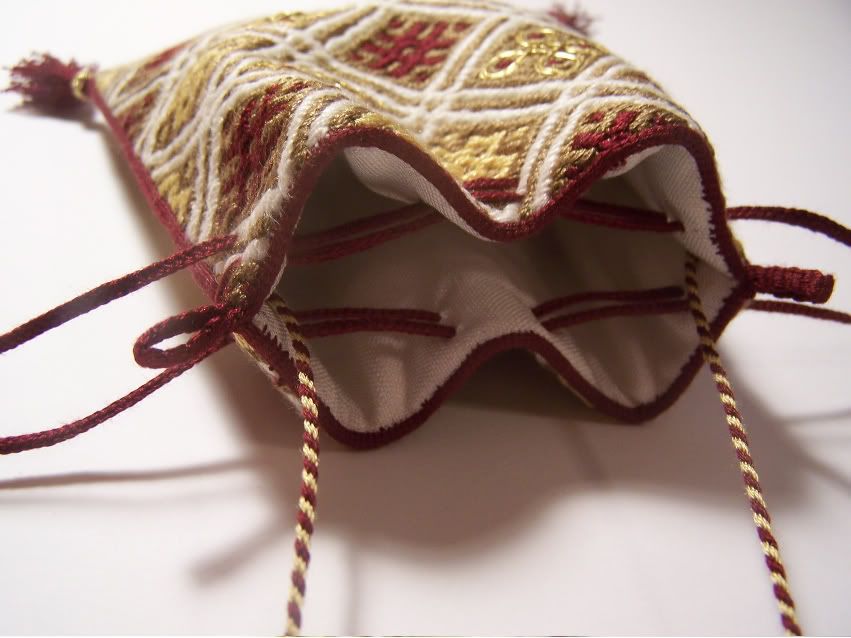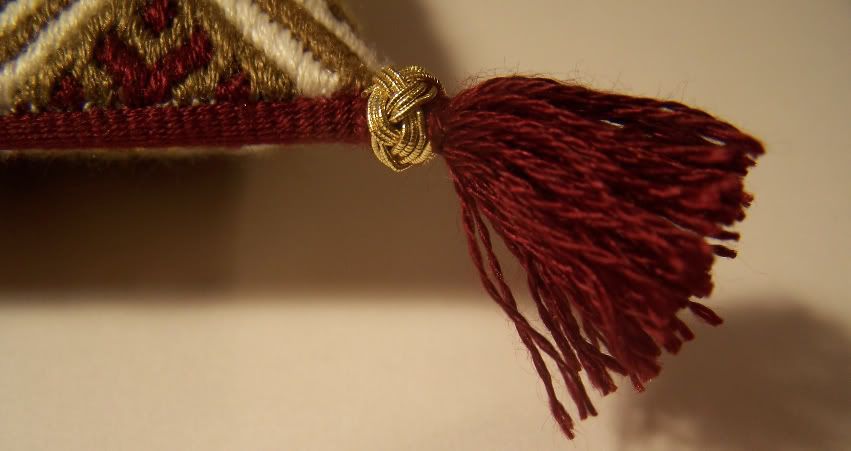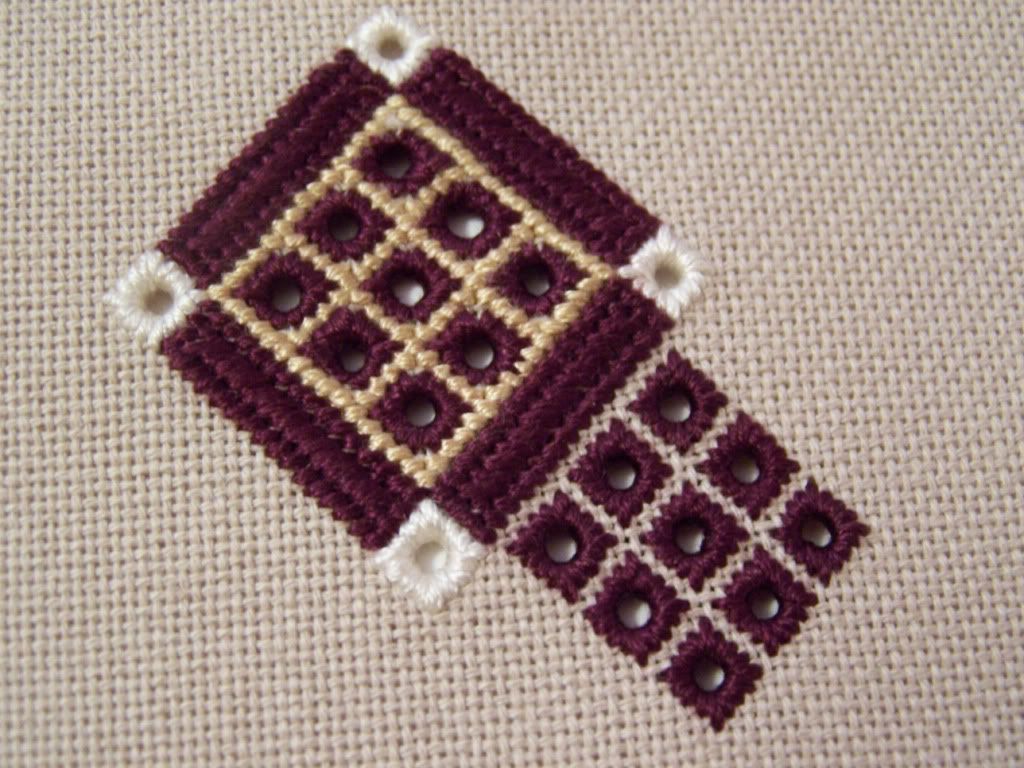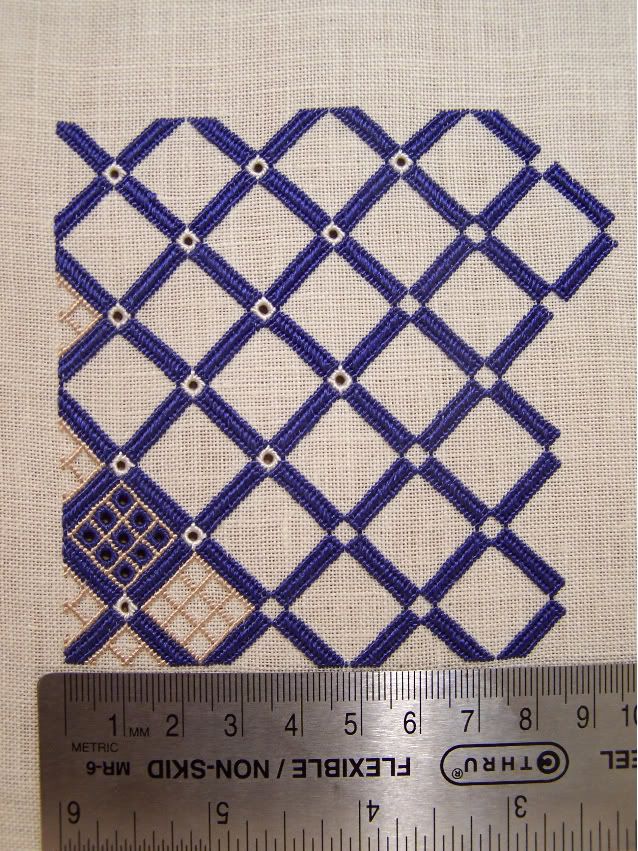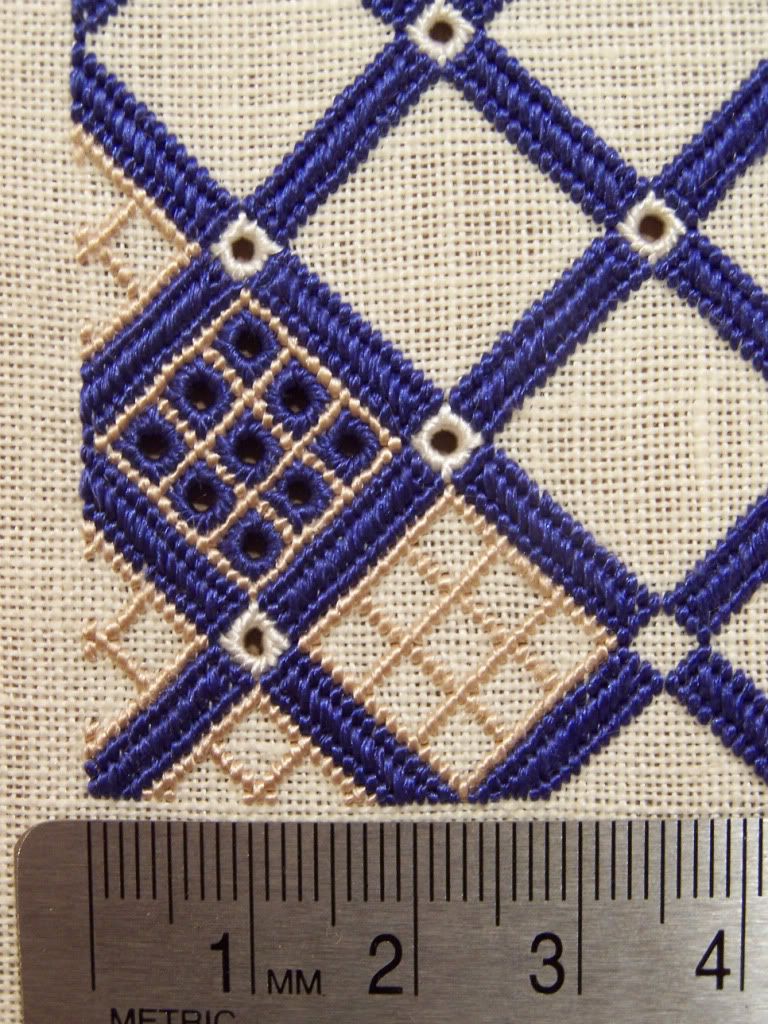
Corner detail:
17 February 2010
08 February 2010
Yes, still here!
I author a few blogs, and posting is fairly infrequent on all of them. However, I always feel a bit guilty about going quiet on this one, since I know there are a decent amount of people who visit it. And while I'm on the subject, thank you all for visiting and commenting—knowing there are people out there with similar interests is a big part of what keeps me motivated!
A few things for today's post:
• I've made some progress on the latticework purse, but haven't taken any pictures recently. I'll get around to that before the week is out.
• I've been working on a mock-up for a 16th century frame purse—my first commission, for a friend of mine—but the pattern I've come up with need some serious re-working, because I'm not at all happy with it. Expect to hear more as this project develops.
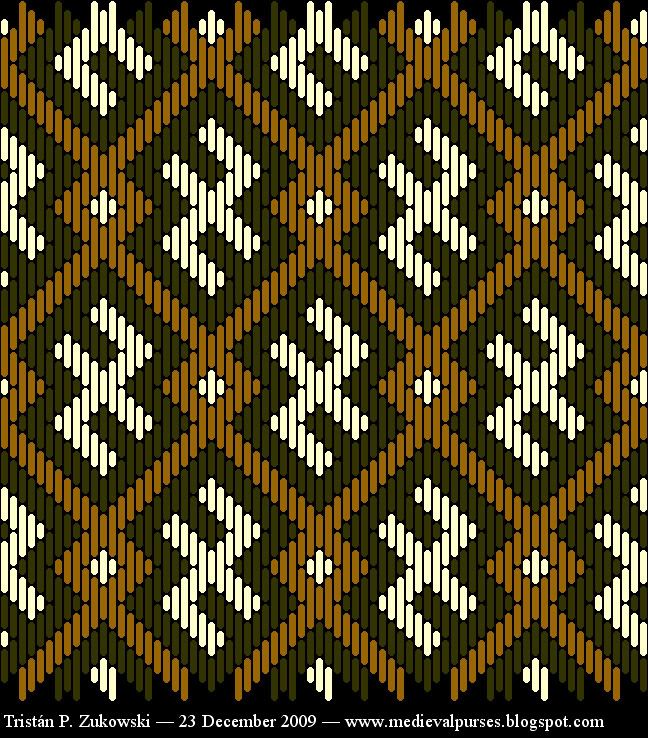
• A while back, I came up with some patterns, not necessarily based on any extant pieces, but just getting some ideas on paper (or the computer screen, rather) for my next few projects. These are much simpler than the recent pattern redactions I've posted, and I wasn't originally planning on posting them.. but why not! Here they are:

• Speaking of patterns, I'm continually impressed with my friend Racaire's adaptation of one of my patterns. For those of you who aren't familiar with her and her work, here's her latest progress on that piece.
That's all I have to offer tonight :-)
A few things for today's post:
• I've made some progress on the latticework purse, but haven't taken any pictures recently. I'll get around to that before the week is out.
• I've been working on a mock-up for a 16th century frame purse—my first commission, for a friend of mine—but the pattern I've come up with need some serious re-working, because I'm not at all happy with it. Expect to hear more as this project develops.
• A while back, I came up with some patterns, not necessarily based on any extant pieces, but just getting some ideas on paper (or the computer screen, rather) for my next few projects. These are much simpler than the recent pattern redactions I've posted, and I wasn't originally planning on posting them.. but why not! Here they are:
• Speaking of patterns, I'm continually impressed with my friend Racaire's adaptation of one of my patterns. For those of you who aren't familiar with her and her work, here's her latest progress on that piece.
That's all I have to offer tonight :-)
24 October 2009
27 September 2009
Spider silk textile project
A friend sent me an interesting article on a project involving a million spiders, and the resulting textile woven from their silk. Read that here: http://www.wired.com/wiredscience/2009/09/spider-silk/
03 September 2009
An email from the ether..?
This afternoon I received an email from a Dr. Anna Kyritsi about a 7-day "EU Grundtvig Workshop in Cyprus" on needlework and traditional 'female' art. It mentioned the possibility of a grant that would cover even the cost of travel. Naturally, I'm intrigued, and yet I have no idea how this email came to be in my inbox. It doesn't appear to have been forwarded by anyone whom I know, nor do I ever recall signing up for any such email notification. And it made it past my spam filter.
Do any of you fellow textile people know anything about this? The website is this: www.biolearning.eu
01 September 2009
13th century brick stitch pattern, revised version
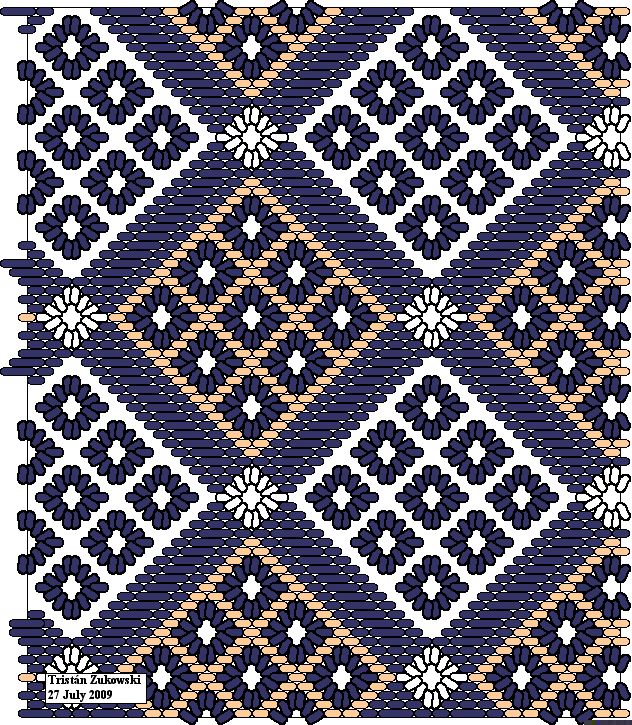
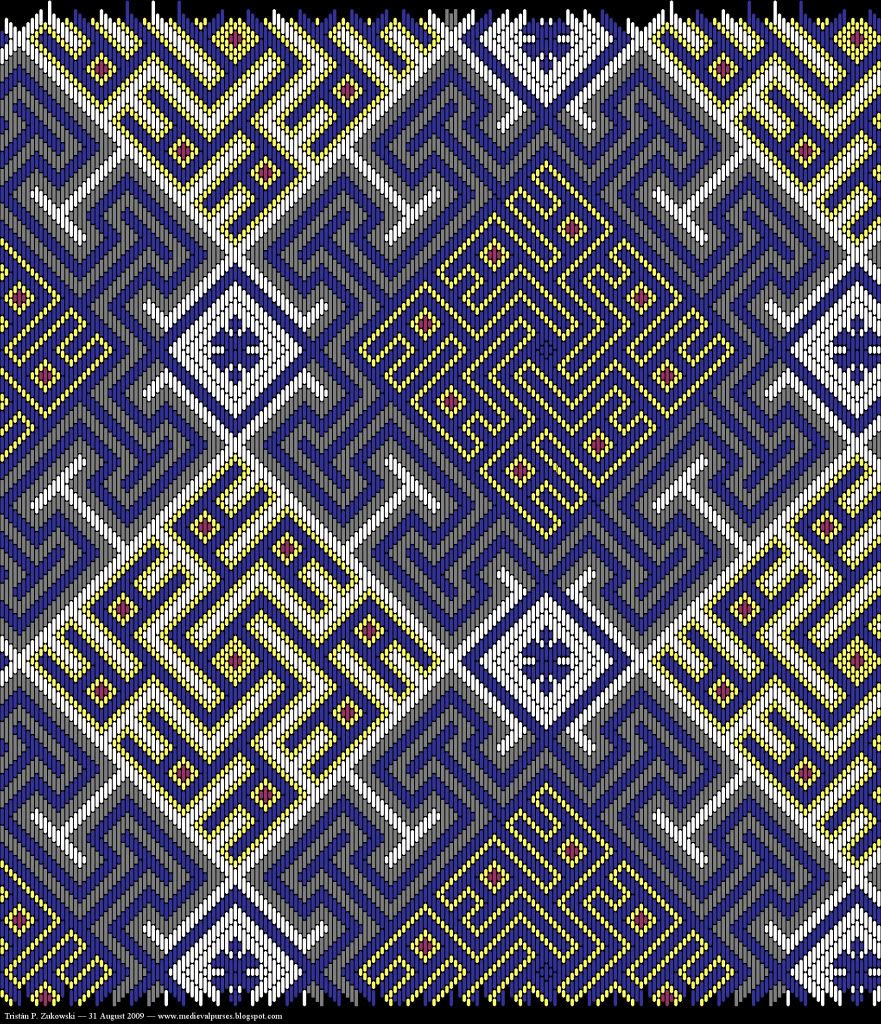
As promised, here's the pattern I've come up with to account for the tantalizing gaps in KIK/IRPA object no. 43380. 49% squinting at the computer screen, 51% guesswork:
Warning: the image is pretty big. Probably bigger than it needed to be.

The grey areas are where the ground fabric seems to be consistently exposed. Much like the last pattern I posted, this could be due to caustic dyestuff eating away the threads, intentional picking out of thread (maybe it was gold!), left like that intentionally for a textured effect, or perhaps some other reason that I just can't think of yet. I have no data yet as to which reason is more likely.
Warning: the image is pretty big. Probably bigger than it needed to be.
The grey areas are where the ground fabric seems to be consistently exposed. Much like the last pattern I posted, this could be due to caustic dyestuff eating away the threads, intentional picking out of thread (maybe it was gold!), left like that intentionally for a textured effect, or perhaps some other reason that I just can't think of yet. I have no data yet as to which reason is more likely.
31 August 2009
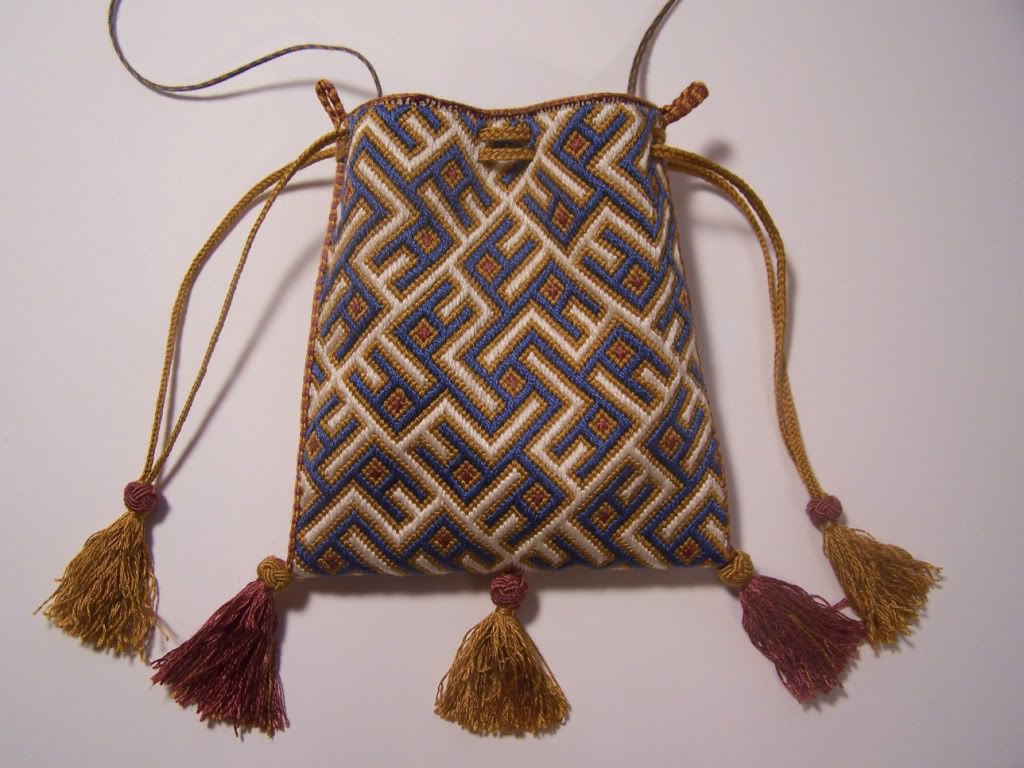
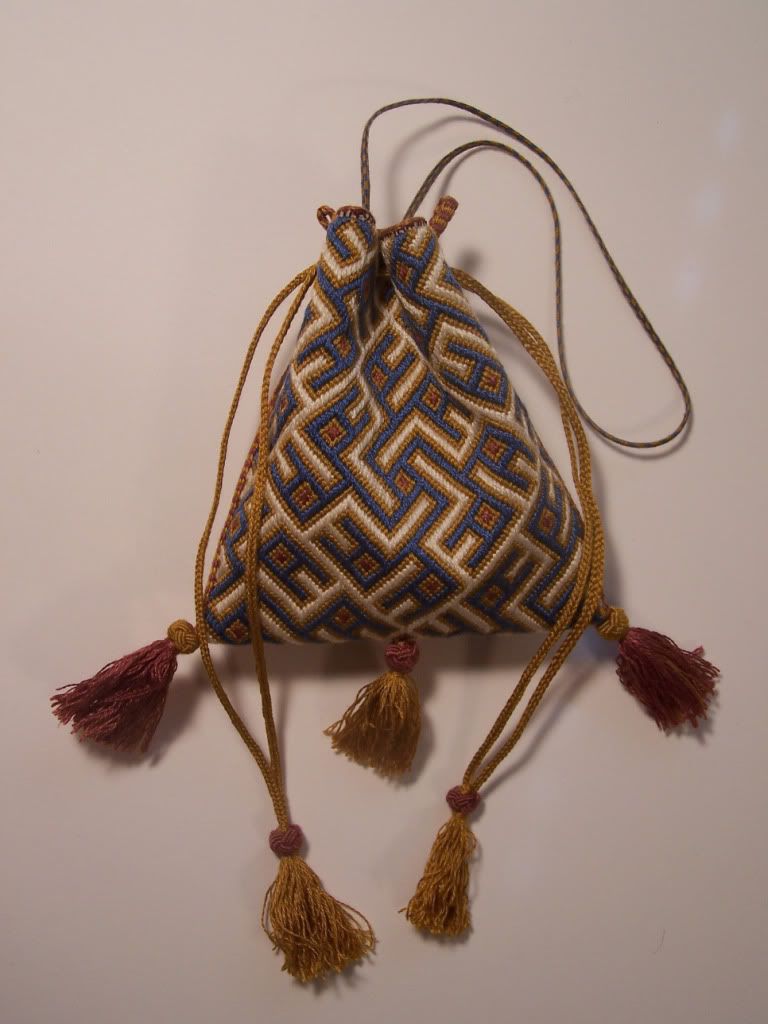
Blue, white & gold purse finished!
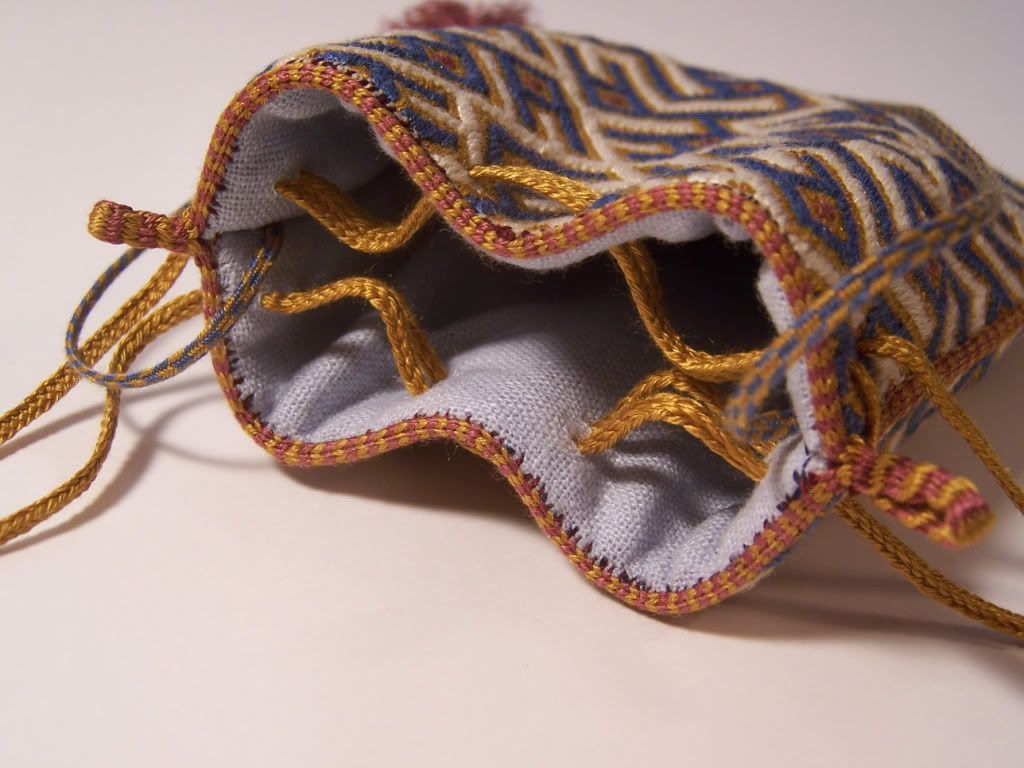
Materials for this purse: 32-ct ground (cotton, I think), light blue linen lining (just something I had laying around). Embroidery worked in Kreinik silk floss (1096, 2016, 5013 & 7172).
The drawstrings were worked with pairs of individual strands of the Kreinik floss in a broad lace of 5 loops; the suspension loop with single strands in a lace piol (braids #1 and #14 in Tak v Bowes.., respectively). While I'm very happy with the quality and fineness of the suspension loop—if I may say so myself!—I do think it's proportionally too small for this purse. However, since it took me around 8 hrs to make that length of braid, I wasn't about to scrap it and start again.
The gimp thread for the turkshead knots were also made from the Kreinik floss, plied and wound around a linen core. I'm not entirely happy with the result (at this point, I was just trying to be consistent by using the same type of threads for everything), but the resulting knots are passable for my first attempts. I may replace the first two I made at a later date, since I quickly got better at tying them, and they look noticeably worse than the rest (at least to me!)
The side-stitching, as you can see, was worked in two colors. I was very happy with the result, except for the fact that I should have doubled the threads in each tablet hole; the woven band ended up being slightly too narrow for adequate coverage of the seams and some "blank space" can be seen peeking through, as well as the warp-stitches. Live and learn..
23 August 2009
Brickstitch purse with gold: finished!
Embroidery pattern adapted from A Stitch Out of Time by T. J. Mitchell (aka Richard Wymarc).
Materials: 32-count linen ground, silk (unknown remnant) lining. Embroidery worked in Kreinik silk flosses (1119, 2015, 2017), DMC linen floss, and gold passing thread.
The drawstrings were worked with pairs of individual strands of the Kreinik floss in a broad lace of 5 loops; the suspension loop with individual strands in a lace bend round (braids #1 and #25 in Tak v Bowes Departed, respectively).
The side-stitching was woven with 16 2-hole cards threaded with individual strands of the Kreinik floss.
27 July 2009
Side stitching on purses
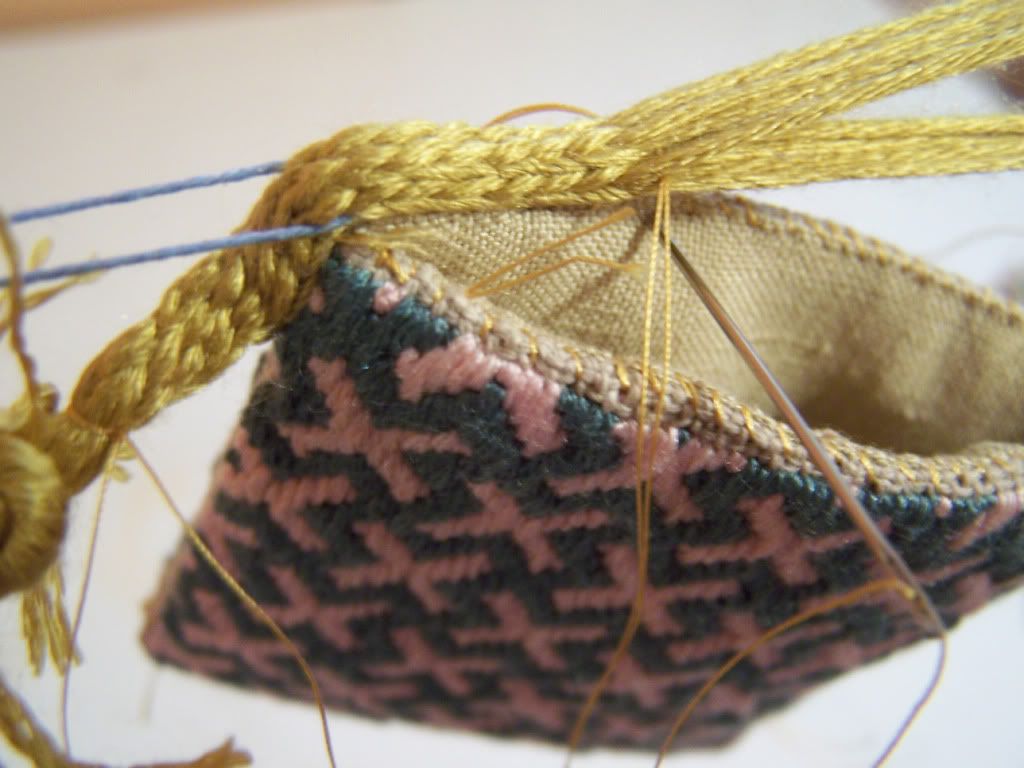
OK, someone a few posts back commented that they'd like to know how I finish my purses. I was taught by a friend of mine, Lois S., a method that's a cross between finger loop braiding and weaving. I was going to try to come up with sketch to illustrate the process, but I ran across a post on the Medieval Silkwork blog that has an illustration already. So, I'll just point you in that direction. If you can't read Dutch any better than I can, fear not, it's frightfully simple: As you switch the loops between fingers (and be consistent about which loop passes through the other... for example, bottom always passing through top), you're creating a shed. The weft — here, your needle and thread — spirals through the shed, than into the edge of the purse, then into the next shed, etc. Continue until it's finished.
As for the direction of the side-stitching: I don't know if anyone's researched this in depth or not. I've gotten into the habit of starting on the top corner, moving across the top edge, and down the side. This way, when I finish I can use the leftover 'warp' for a corner tassel. I can't tell you if this is an historically accurate way of doing it or not; I have neither seen nor done the research myself at this point. As always, comments and criticisms are always welcome :-)
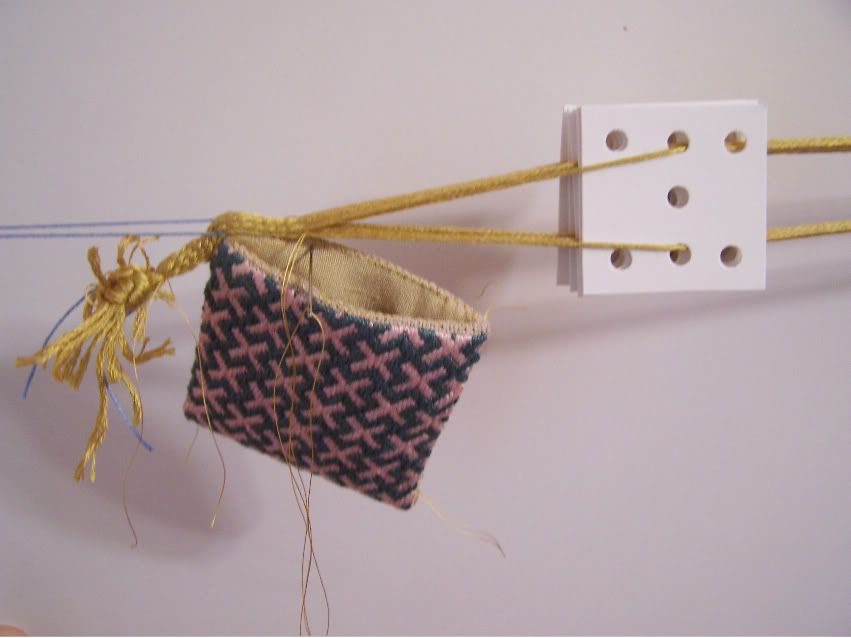
The main problem I've found with the above method is due to the fact that it takes two people to work: one manipulating the loops, one stitching, and both trying to maintain a consistent tension. At the moment, I don't have anyone around to be that second person. So, I've been experimenting with a one-person method; replace the finger loop idea with a series of tablets, with only two threads per tablet, and alternating between Z and S orientation. Move the pack of tablets forward a half-turn for each pick.
With a bit of practice, and some luck, I managed to make it work!


See that blue thread holding on to the purse on the left? When the time comes to turn the corner and work down the side, I'll put another loop through the fabric under the corner, and then attach that to the anchor at the left. This way, you're always working in a straight line, which is obviously what the threads want to do anyway. Obeying the laws of physics is key to not going insane during a project like this..
As for the direction of the side-stitching: I don't know if anyone's researched this in depth or not. I've gotten into the habit of starting on the top corner, moving across the top edge, and down the side. This way, when I finish I can use the leftover 'warp' for a corner tassel. I can't tell you if this is an historically accurate way of doing it or not; I have neither seen nor done the research myself at this point. As always, comments and criticisms are always welcome :-)
The main problem I've found with the above method is due to the fact that it takes two people to work: one manipulating the loops, one stitching, and both trying to maintain a consistent tension. At the moment, I don't have anyone around to be that second person. So, I've been experimenting with a one-person method; replace the finger loop idea with a series of tablets, with only two threads per tablet, and alternating between Z and S orientation. Move the pack of tablets forward a half-turn for each pick.
With a bit of practice, and some luck, I managed to make it work!
See that blue thread holding on to the purse on the left? When the time comes to turn the corner and work down the side, I'll put another loop through the fabric under the corner, and then attach that to the anchor at the left. This way, you're always working in a straight line, which is obviously what the threads want to do anyway. Obeying the laws of physics is key to not going insane during a project like this..
A new pattern
Here's the sample that I did on some scrap fabric (32-ct, I think) with cotton embroidery floss:
The website states that the purse is made of sheep's wool, silk (?), and gold. From just looking at the available pictures, I can't seem to determine where the gold is. I believe this is yet another purse referenced in Frieda Sorber's Tongeren Basiliek O-L-Vrouw Geboorte. I really must get myself a copy of that book.
I'd be interested to hear/see any ideas or alternate interpretations of this piece!
Labels:
embroidery,
experiments,
frame purses,
pattern redaction
Subscribe to:
Posts (Atom)